Understanding PRP, OPRP, and CCP: Essential Food Safety Controls
Updated: Aug 5
If you've ever participated in a HACCP study or faced a food safety audit, you've probably heard the terms PRP, OPRP, and CCP repeatedly. Yet, many food businesses struggle to differentiate between them. Some organizations classify almost every control measure as a CCP, while others fail to identify critical controls that directly impact food safety.
Understanding PRP, OPRP, and CCP correctly is essential for effective food safety management and compliance with standards such as HACCP, ISO 22000, and FSSC 22000. If you're currently implementing HACCP, our Step-by-Step Guide to Implementing HACCP on the Factory Floor explains how hazard analysis leads to the identification of PRPs, OPRPs, and CCPs. Organizations that need support in developing a practical hazard analysis can also benefit from our HACCP Implementation Services.
Let's simplify these concepts with practical industry examples.
Why Do We Need Different Levels of Control?
Not all food safety hazards carry the same level of risk. For example:
Maintaining a clean facility is important.
Ensuring milk is pasteurized at the correct temperature is critical.
Preventing metal contamination through metal detection is highly significant.
Each control requires a different level of monitoring and management. This is where PRPs, OPRPs, and CCPs come into play.
What are PRPs?
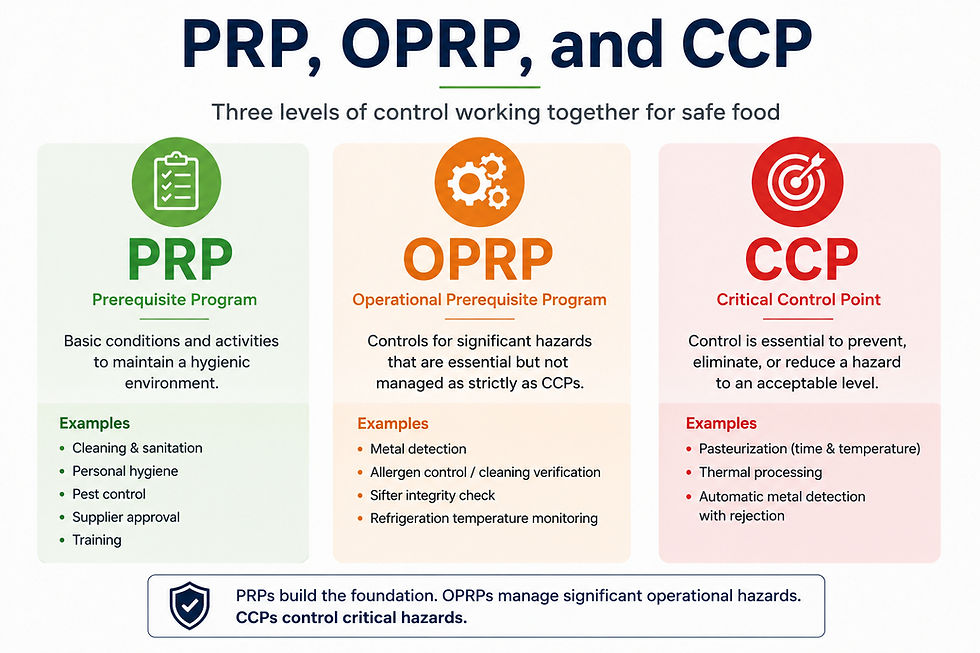
Prerequisite Programs (PRPs) are the foundational conditions and activities necessary to maintain a hygienic environment throughout the food chain. Think of PRPs as the basic food safety practices that every food business must have in place before conducting a HACCP study.
Common Examples of PRPs
Cleaning and sanitation
Pest control
Personal hygiene
Water quality management
Preventive maintenance
Waste management
Supplier approval
Employee training
Facility design and zoning
Practical Example
A biscuit manufacturing facility has a cleaning schedule for production equipment. The cleaning process helps reduce contamination risks but is not designed to control a specific significant hazard identified during hazard analysis. Therefore, cleaning and sanitation are managed as a PRP.
Key Characteristics of PRPs
General controls across the facility
Applicable to multiple products and processes
Managed through SOPs and programs
Not specific to a single significant hazard
What are OPRPs?
Operational Prerequisite Programs (OPRPs) sit between PRPs and CCPs. These are control measures identified through hazard analysis as essential for controlling significant food safety hazards, but they do not require the same level of control as a CCP.
Practical Example 1: Metal Detection
A snack manufacturing plant installs a metal detector at the end of the packaging line. The metal detector helps prevent physical contamination from reaching consumers. The hazard is significant, and the control measure requires monitoring, verification, and corrective action. In many facilities, this control is managed as an OPRP.
Practical Example 2: Allergen Changeover Cleaning
A facility manufactures both peanut-containing and peanut-free products. Cleaning between product changeovers is critical to prevent allergen cross-contact. Since allergen contamination can pose serious health risks, cleaning verification may be managed as an OPRP.
Key Characteristics of OPRPs
Hazard-specific controls
Identified through hazard analysis
Require monitoring and corrective actions
Usually have measurable or observable criteria
More rigorous than PRPs but less stringent than CCPs
What are CCPs?
A Critical Control Point (CCP) is a step where control is essential to prevent, eliminate, or reduce a food safety hazard to an acceptable level. Loss of control at a CCP can directly result in unsafe food.
Practical Example 1: Milk Pasteurization
In a dairy plant, pasteurization is used to destroy pathogenic microorganisms. The process must achieve validated time and temperature requirements. Failure of this step can result in unsafe product reaching consumers. Therefore, pasteurization is typically classified as a CCP.
Practical Example 2: Thermal Processing of Canned Foods
In canned food production, thermal processing is essential to destroy harmful microorganisms such as Clostridium botulinum. The process has validated critical limits and requires strict monitoring. This is a classic example of a CCP. During certification projects, incorrect CCP identification is one of the most common findings. In our article on Why Companies Fail FSSC 22000 Audits Even After Full Preparation, we discuss how poor hazard analysis and weak justification often lead to audit nonconformities.
Key Characteristics of CCPs
Directly control significant hazards
Have validated critical limits
Require strict monitoring
Immediate action is required when limits are exceeded
Often involve continuous or highly frequent monitoring
Understanding PRP, OPRP, and CCP Through a Food Manufacturing Example
Consider a milk powder manufacturing facility.
Activity | Classification | Why? |
Personnel hygiene program | PRP | General hygiene control |
Pest control program | PRP | Facility-wide preventive control |
Sifter integrity checks | OPRP | Controls physical contamination risk |
Allergen cleaning verification | OPRP | Controls significant allergen hazard |
Pasteurization | CCP | Eliminates pathogenic microorganisms |
This example demonstrates how PRP, OPRP, and CCP work together to create multiple layers of food safety protection.

Common Mistakes When Managing PRP, OPRP, and CCP
1. Too Many CCPs
Some organizations classify every significant control measure as a CCP. This creates unnecessary monitoring requirements and documentation burdens.
2. Ignoring OPRPs
Many HACCP teams move directly from PRPs to CCPs and overlook OPRPs entirely. This can leave important operational controls inadequately managed.
3. Weak Hazard Analysis
Improper hazard assessment often leads to incorrect classification of controls. Regular internal audits can help identify these gaps before certification or customer audits. A structured Internal Audit Checklist for Food Manufacturers can be a valuable tool for verifying whether PRPs, OPRPs, and CCPs are being managed effectively.
4. No Scientific Justification
Auditors frequently ask:
Why is this a CCP?
Why is this not a CCP?
What is the basis for this classification?
Organizations should always be able to justify their decisions using hazard analysis and risk assessment.
How ISO 22000 and FSSC 22000 Manage PRP, OPRP, and CCP?
Unlike traditional HACCP systems that focus primarily on CCPs, ISO 22000 introduces a structured approach that includes:
PRPs
OPRPs
CCPs
The standard requires organizations to determine the appropriate category based on:
Severity of the hazard
Likelihood of occurrence
Position of control in the process
Feasibility of monitoring
Consequences of failure
This risk-based approach provides greater flexibility and stronger food safety management.
Businesses often struggle to understand how HACCP fits within broader management systems. Our guide on ISO 22000 vs FSSC 22000 explains how PRPs, OPRPs, and CCPs are managed under each framework.
For businesses preparing for certification, our FSSC 22000 Consultancy Services help establish scientifically justified PRPs, OPRPs, and CCPs that stand up to certification audits. Before implementation, you may also find our guide on FSSC 22000 Audit Preparation: How to Prepare Your Factory for Certification useful for understanding what auditors expect during certification.
Need Help Identifying PRP, OPRP, and CCP?
Many food businesses either classify too many CCPs or fail to identify critical operational controls. At 2F Quality Solutions, we help food manufacturers develop practical HACCP plans, establish scientifically justified control measures, and prepare for ISO 22000 and FSSC 22000 certification audits. A professional Gap Assessment and Internal Audit can identify weaknesses before external certification audits and help strengthen your food safety management system.
Conclusion
PRP, OPRP, and CCP are not competing concepts — they work together to protect food safety. Think of them as three layers of protection:
PRPs create a hygienic foundation.
OPRPs manage significant operational hazards.
CCPs control the most critical food safety risks.
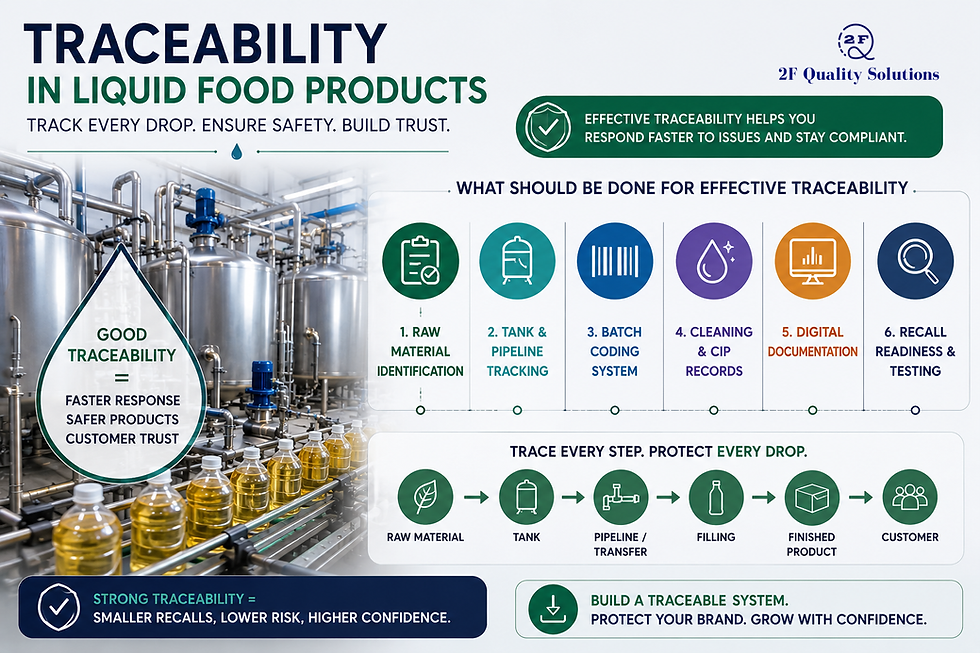
Hazard controls should also be periodically tested to verify that traceability and corrective action processes work effectively. Conducting regular Mock Recall Exercises helps organizations evaluate the effectiveness of their food safety management systems under real-world conditions. A well-designed food safety management system uses all three effectively, ensuring that food safety controls are practical, scientifically justified, and audit-ready.
The next time your HACCP team discusses hazard controls, remember that not every control is a CCP — and understanding the difference between PRP, OPRP, and CCP can make your entire food safety system stronger.


Comments