FSSC 22000 Audit Preparation: How to Prepare Your Factory for Certification
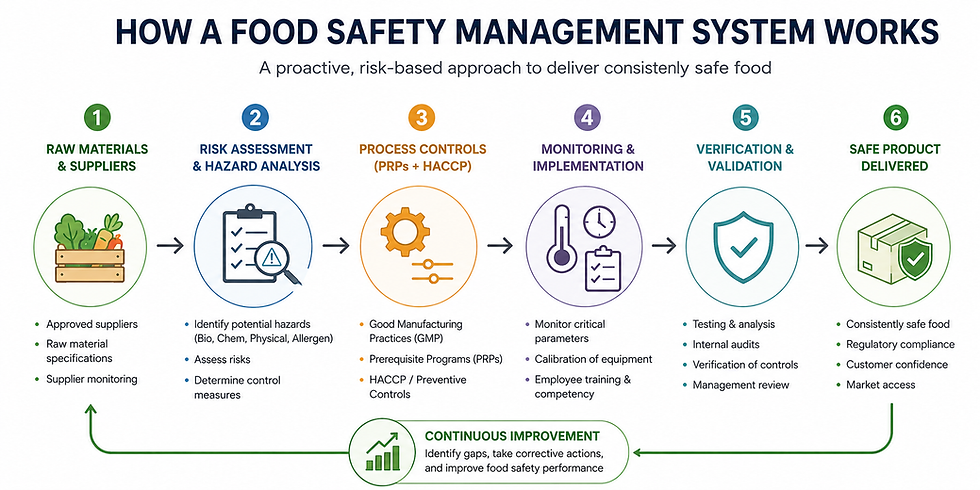
Preparing for an FSSC 22000 audit requires much more than having complete documentation. Auditors evaluate how effectively your Food Safety Management System (FSMS) is implemented across the organization—from leadership commitment and prerequisite programmes (PRPs) to HACCP, operational controls, verification activities, and continual improvement.
Whether you're preparing for your first certification audit, a surveillance audit, or transitioning to FSSC 22000 Version 7, understanding what auditors expect can significantly improve your readiness and reduce the risk of nonconformities.
In this guide, we'll walk you through the key areas auditors assess, common mistakes organizations make, and practical steps to help you prepare your factory for a successful FSSC 22000 certification audit.
In this guide you'll learn:
Structure of FSSC 22000
What auditors evaluate
Pre-audit preparation checklist
Common nonconformities
Audit day best practices
Final readiness checklist
Version 7 Update FSSC 22000 Version 7 aligns the certification scheme with the latest GFSI Benchmarking Requirements and updated sector-specific PRP standards. While the core structure of FSSC 22000 remains unchanged, organizations should ensure their Food Safety Management System is aligned with the latest Version 7 requirements before certification or surveillance audits. |
If you're still deciding which certification programme is right for your business, start with our guide on Food Safety Standards: A Complete Guide to Global Food Safety Certification Programmes before preparing for certification.
Understanding the Structure of FSSC 22000
FSSC 22000 certification is built on three key components:

1. ISO 22000 – Food Safety Management System
ISO 22000 defines the management system framework for food safety, including:
Context of the organization
Leadership and management responsibility
Planning, risk-based thinking and opportunities
Operational control through HACCP
Performance evaluation and improvement
ISO 22000 ensures the FSMS operates as a structured management system rather than a set of isolated procedures.
2. Prerequisite Programs (PRPs)
FSSC 22000 requires organizations to implement the applicable sector-specific PRP standard depending on their scope of certification:
ISO/TS 22002-1 for food manufacturing
ISO/TS 22002-4 for food packaging
ISO/TS 22002-6 for feed production
ISO/TS 22002-5 for Transport and storage
ISO/TS 22002-100 unified across food chain categories
These PRPs define detailed operational hygiene and infrastructure requirements.
FSSC 22000 Version 7 incorporates the latest revisions of applicable PRP standards within the certification scheme.
3. FSSC Additional Requirements
Beyond ISO 22000 and PRPs, FSSC includes scheme-specific clauses covering:
Food safety culture
Food defense
Food fraud mitigation
Equipment management
Environmental monitoring (where applicable)
Quality control
Food loss and waste
Management of services and purchased materials
These additional elements are often decisive during certification audiExample ts.
Key Areas to Prepare for an FSSC 22000 Audit
1. Leadership, Food Safety Culture and Management Commitment
Auditors begin by evaluating whether the FSMS is supported by management.
Important audit points include:
Food safety policy communication
Defined food safety objectives
Management review records
Resource allocation for food safety
Roles and responsibilities within the FSMS
Common audit findings occur when management review meetings are conducted but action items are not tracked or verified.
2. Hazard Analysis and HACCP Plan
The HACCP plan must be scientifically justified and aligned with actual production processes.
Auditors typically verify:
Hazard identification for biological, chemical, and physical risks
Determination of CCPs and OPRPs
Validation of control measures
Verification of current HACCP plan
Monitoring procedures
Verification activities
A frequent issue is hazard analysis copied from templates without considering plant-specific risks.
3. Prerequisite Program Implementation (ISO/TS 22002)
PRPs provide the foundation for hazard control.
Under ISO/TS 22002-1, auditors examine:
A. Facility Design and Layout
Hygienic zoning
Controlled material flow
Separation of raw and finished areas
B. Cleaning and Sanitation
Validated cleaning procedures
Chemical control
Cleaning verification records
C. Pest Control
Pest monitoring systems
Inspection frequency
Corrective actions
D. Equipment Maintenance
Preventive maintenance plans
Lubrication control
Equipment hygiene design
E. Personnel Hygiene
Hygiene facilities
Handwashing practices
Protective clothing procedures
Weak PRP implementation is one of the most common reasons for audit non-conformities.
4. Traceability and Product Recall Systems
Traceability systems must allow rapid identification of affected products.
Auditors evaluate:
Raw material traceability
Finished goods traceability
Batch coding systems
Traceability within acceptable timeframes
Mock recall performance
Most certification bodies expect traceability demonstration within 2–4 hours, though it varies. It is important that the organizations demonstrate an effective traceability system and successfully complete a mock recall within the timeframe defined by their procedures and customer or regulatory requirements.
5. Supplier Approval and Raw Material Control
Supplier management is critical for controlling incoming hazards.
Audit checkpoints include:
Approved supplier list
Supplier risk assessment
Certificates of analysis verification
Supplier performance monitoring
Re-evaluation frequency
Common audit findings include incomplete supplier evaluations, outdated approvals, inadequate risk assessments, and ineffective monitoring of supplier performance.
6. Documentation and Record Control
Effective FSMS implementation requires disciplined documentation practices.
Auditors review:
Version control of procedures
Record correction practices
Internal audit reports
Corrective action records
CAPA verification
Frequent findings include overwriting in records and incomplete corrective actions.
7. Internal Audits and System Verification
Internal audits ensure the system remains effective between certification audits.
Auditors expect:
Annual internal audit plans
Audit coverage across departments
Root cause analysis for findings
Corrective action follow-up
Internal audits should identify system weaknesses before external auditors do.
8. FSSC 22000 Additional Requirements
Beyond ISO 22000 and the applicable Prerequisite Programmes (PRPs), FSSC 22000 includes several scheme-specific requirements that auditors evaluate during certification.
Food Safety Culture
Evidence that management promotes a positive food safety culture through leadership, communication, training, and employee engagement.
Food Defense
Assessment of intentional contamination risks and implementation of appropriate site security and access control measures.
Food Fraud Prevention
Vulnerability assessment of raw materials and supply chains, along with mitigation measures to reduce the risk of economically motivated adulteration.
Allergen Management
Identification, segregation, handling, and labeling controls to prevent unintended allergen cross-contact.
Related read: Navigating Allergen Management in Food Industries: Unveiling Its Critical Importance and Testing Essentials
Environmental Monitoring
A risk-based environmental monitoring programme for microbiological hazards, where applicable to the manufacturing process.
Equipment Management
Controls to ensure equipment is hygienically designed, maintained, calibrated, and suitable for producing safe food.
Transport and Storage
Controls to maintain product safety and integrity during storage, handling, and distribution, including temperature control where applicable.
Quality Control
Processes to ensure products consistently meet defined quality specifications alongside food safety requirements.
Food Loss and Waste
Measures to identify, control, and minimize food loss and waste where relevant to the organization's operations.
Management of Services and Purchased Materials
Evaluation and control of outsourced services, purchased materials, utilities, and external providers that may affect food safety.
Many audit non-conformities arise when these additional requirements are documented but not effectively implemented, monitored, and integrated into day-to-day operations.

Common Audit Findings in FSSC 22000 Audits
Typical issues observed during audits include:
Incomplete hazard analysis updates
Ineffective CCP/OPRP monitoring
Weak CAPA implementation
Poor documentation practices
Inadequate cleaning verification
Weak supplier approval process
Incomplete internal audit follow-up
These findings usually indicate gaps in system implementation rather than documentation availability.
Using a Factory Readiness Checklist
Before a certification audit, organizations should conduct a structured internal readiness assessment covering all key elements of the Food Safety Management System. To help manufacturers evaluate system readiness, we have prepared a Factory Readiness Checklist for ISO 22000 and FSSC 22000 Audits.
The checklist covers:
Management commitment
HACCP validation
PRP implementation
Traceability systems
Supplier approval
Documentation discipline
FSSC additional requirements
Key Takeaways for Audit Readiness
Area | What Auditors Expect to See |
Documentation | Food Safety Policy, FSMS documents, SOPs, records and controlled documents |
Production Operations | PRPs, GMP/GHP, process controls, CCPs/OPRPs, monitoring records |
Personnel | Competency records, training, food safety awareness and hygiene practices |
Equipment & Maintenance | Preventive maintenance, calibration, equipment condition and maintenance records |
Laboratory & Verification | Testing plans, verification activities, validation and laboratory records |
Supplier Management | Approved supplier programme, supplier evaluations and incoming material controls |
Traceability & Recall | Traceability records, mock recall results and product identification |
Internal Audits | Internal audit programme, audit reports, corrective actions and follow-up |
Management Review | Management review records, objectives, KPIs and continual improvement actions |
FSSC Additional Requirements | Food safety culture, quality control, equipment management, food loss & waste, and other applicable FSSC requirements |
FSSC 22000 audits evaluate the maturity of a factory’s food safety management system.
Facilities that maintain continuous monitoring, structured verification, and operational discipline typically perform better during certification audits.
Preparing for an FSSC audit should therefore focus on system implementation, verification activities, and cross-functional involvement, rather than last-minute document preparation.
Preparing for the Transition to FSSC 22000 Version 7
FSSC 22000 Version 7 was officially published in May 2026 and introduces updates to align the certification scheme with the latest GFSI Benchmarking Requirements, revised ISO 22002-x Prerequisite Programmes, and emerging industry expectations. Organizations currently certified to Version 6 have a 12-month transition period, with Version 7 audits beginning from 1 May 2027.
If your organization is planning a certification or surveillance audit, now is the ideal time to review your Food Safety Management System, understand the new requirements, and identify any gaps. Early preparation can help minimize disruptions and ensure a smooth transition to Version 7.
At 2F Quality Solutions, we support food manufacturers with FSSC 22000 implementation, internal audits, gap assessments, and transition planning to help them confidently meet the latest certification requirements.
If your certification audit is scheduled after 1 May 2027, discuss your transition plan with your certification body well in advance.
Conclusion
Preparing your factory for an FSSC 22000 audit requires aligning three key elements:
ISO 22000 food safety management system requirements
ISO/TS 22002 prerequisite programs
FSSC scheme-specific additional requirements
Factories that integrate these elements into daily operations demonstrate stronger food safety culture and achieve smoother audit outcomes.
Audit success is ultimately the result of system discipline rather than audit preparation alone.
Related Reads:
Frequently Asked Questions (FAQs)
How do I prepare for an FSSC 22000 audit?
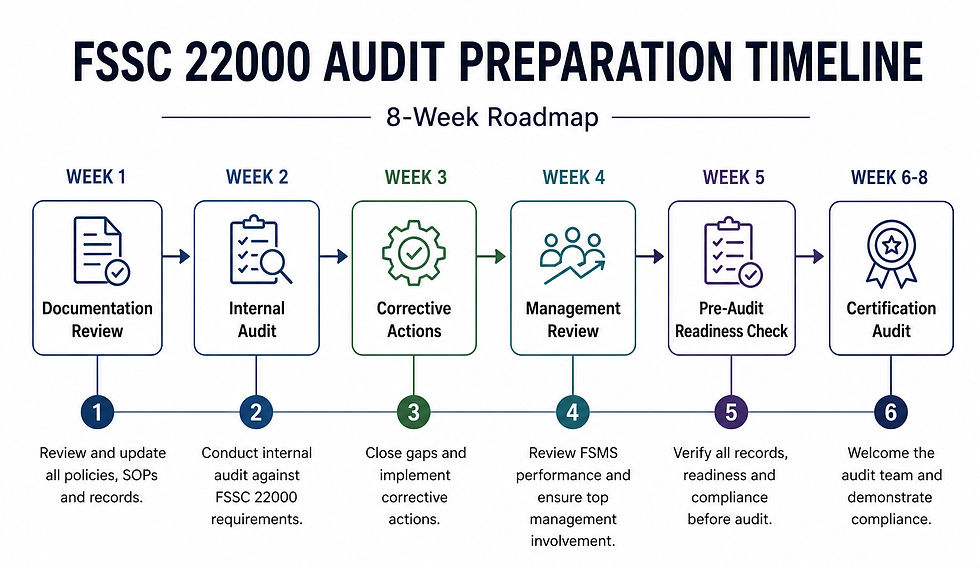
Start by reviewing your Food Safety Management System (FSMS), conducting internal audits, verifying HACCP plans, implementing prerequisite programmes (PRPs), reviewing supplier controls, and ensuring records demonstrate consistent implementation. Management review and corrective actions should be completed before the certification audit.
What do FSSC 22000 auditors check during an audit?
Auditors typically evaluate:
Leadership and management commitment
HACCP implementation
Prerequisite Programmes (PRPs)
Food safety culture
Documentation and records
Supplier management
Traceability and mock recall
Internal audits
Corrective actions
FSSC Additional Requirements
What are the most common FSSC 22000 audit nonconformities?
Common findings include:
Incomplete hazard analysis
Weak corrective action implementation
Poor document control
Inadequate supplier monitoring
Weak verification activities
Incomplete internal audit follow-up
Gaps in prerequisite programme implementation
How long does it take to prepare for FSSC 22000 certification?
The preparation time depends on the organization's existing Food Safety Management System, operational maturity, and available resources. Organizations with established food safety systems may require only a few weeks of preparation, while first-time implementations can take several months.
What documents are required for an FSSC 22000 audit?
Typical documents include:
Food Safety Policy
HACCP Plan
SOPs
PRP procedures
Internal audit reports
Management review records
Training records
Supplier approval records
Calibration and maintenance records
Traceability and mock recall records
Is FSSC 22000 Version 7 mandatory?
Yes. Organizations should transition according to the timelines established by the FSSC Foundation and their certification body. Version 7 aligns the scheme with the latest GFSI Benchmarking Requirements and introduces updated scheme requirements.


Comments