Food Safety Standards: A Complete Guide to Global Food Safety Certifications
Updated: Aug 5
Food safety is no longer just a regulatory requirement—it's a business necessity. Whether you're a food manufacturer, ingredient supplier, exporter, or retailer, producing safe food is essential for protecting consumers and building trust.
As customer expectations grow and global food supply chains become more complex, businesses are increasingly expected to follow internationally recognized food safety standards. In many cases, certification is no longer optional—it's a requirement to supply major retailers, export products, or work with multinational brands.
Food safety standards provide a structured approach to identifying hazards, controlling risks, and consistently producing safe food. They help businesses improve compliance, strengthen customer confidence, and reduce the risk of costly product recalls.
In this guide, you'll learn:
Whether you're a startup food manufacturer, an established processor, an ingredient supplier, or an exporter looking to expand into international markets, this guide will help you understand the global food safety landscape and make informed decisions for your business.
What Are Food Safety Standards?
Food safety standards are documented requirements, guidelines, and management systems designed to ensure that food is consistently produced, handled, processed, stored, and distributed in a manner that protects consumer health.
Unlike food safety regulations, which are established and enforced by governments, food safety standards provide organizations with a structured framework for managing food safety risks throughout the food supply chain. These standards are voluntary, and outline best practices for identifying hazards, implementing preventive controls, monitoring critical processes, maintaining documentation, training employees, and continually improving food safety performance.
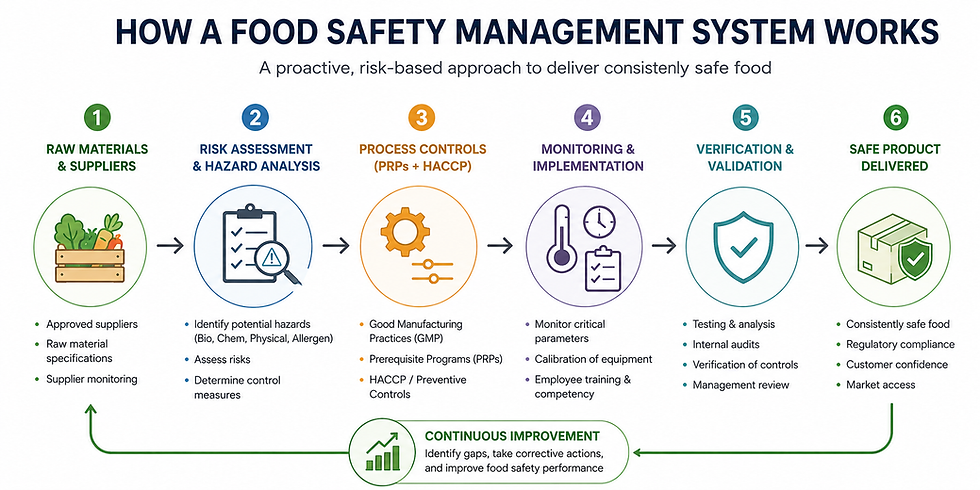
Rather than focusing solely on testing the final product, modern food safety standards emphasize preventing problems before they occur. This preventive approach helps organizations identify potential biological, chemical, physical, and allergen hazards at every stage of production and implement controls to minimize these risks.
For example, instead of relying only on end-product microbiological testing, a food safety management system ensures that raw material approval, cleaning and sanitation, equipment maintenance, personnel hygiene, environmental monitoring, and process controls all work together to consistently produce safe food.
As global supply chains become more complex, food safety standards also improve traceability, supplier management, and communication across the entire production network. This enables businesses to respond quickly to food safety incidents, conduct effective product recalls when necessary, and demonstrate compliance to customers, certification bodies, and regulatory authorities.
Today, internationally recognized standards such as FSSC 22000, BRCGS Food Safety, SQF, IFS, ISO 22000, HACCP, and GMP provide organizations with proven frameworks for managing food safety while meeting customer and market expectations.
The Core Objectives of Food Safety Standards
Food safety standards do more than help businesses achieve certification. They provide a structured system for producing safe food, meeting customer expectations, and improving everyday operations.
Whether you're a small food manufacturer or a global exporter, implementing food safety standards can help reduce risks, improve efficiency, and strengthen your reputation in the market.
Here are the key benefits of implementing food safety standards.
Protect Consumer Health
The primary purpose of any food safety standard is to minimize the risk of foodborne illness.
By identifying biological, chemical, physical, and allergen hazards before products reach the market, businesses can significantly reduce food safety risks.
Ensure Regulatory Compliance
Food businesses must comply with applicable food laws in the countries where they operate and sell their products.
Implementing food safety standards helps establish documented systems that support regulatory compliance and make inspections and audits more manageable.
Build Customer Trust
Customers want confidence that the food they purchase is safe.
Certification to recognized food safety standards demonstrates your commitment to producing safe, high-quality products, helping build trust with customers, retailers, and business partners.
Access New Markets
Many retailers, exporters, and multinational food companies require suppliers to be certified to recognized food safety standards.
Certification can help businesses enter new domestic and international markets while improving their competitive advantage.
Reduce Product Recalls
A product recall can result in financial losses, legal issues, and long-term damage to your brand.
Food safety standards focus on preventing problems before they occur through hazard analysis, process controls, traceability, and corrective actions.
Improve Operational Efficiency
Standardized procedures help reduce errors, minimize waste, and improve consistency across production.
Many businesses also experience better communication, clearer responsibilities, and improved process control after implementing a Food Safety Management System.
Strengthen Traceability
Food safety standards require businesses to establish effective traceability systems that can quickly identify affected products if a food safety issue occurs.
This helps organizations respond faster and manage recalls more effectively.
Promote a Food Safety Culture
Food safety depends on people as much as processes.
Regular training, employee involvement, and strong leadership help create a culture where everyone understands their role in producing safe food.
Food safety standards help businesses produce safe food, comply with regulations, build customer trust, improve efficiency, reduce risks, and create opportunities for business growth.
Key Elements Common to Most Food Safety Standards
Although each certification scheme has its own specific requirements, most recognized food safety standards are built around similar principles:
Hazard identification and risk assessment
Good Manufacturing Practices (GMPs)
Documented procedures and record keeping
Cleaning and sanitation programs
Traceability and product recall systems
Internal audits and management review
Corrective and preventive actions
Continuous improvement
These elements work together to create a proactive food safety management system rather than relying solely on inspection or product testing.
Food Safety Standards vs Food Safety Regulations
The terms food safety standards and food safety regulations are often used interchangeably, but they are not the same.
Food safety regulations are legal requirements established by government authorities to protect public health. Every food business must comply with these laws to operate legally.
Food safety standards, on the other hand, are structured frameworks that help businesses consistently produce safe food. While many standards are voluntary, they are often required by customers, retailers, and international buyers.
The table below highlights the key differences.
Food Safety Standards | Food Safety Regulations |
Developed by international organizations or private certification bodies | Established by government authorities |
Usually voluntary (unless required by customers) | Mandatory and legally enforceable |
Focus on building a Food Safety Management System | Focus on meeting legal requirements |
Often require third-party certification | Enforced through inspections and regulatory audits |
Help improve customer confidence and market access | Help ensure public health and legal compliance |
Examples: FSSC 22000, BRCGS, SQF, IFS, ISO 22000, HACCP | Examples: FSSAI (India), FDA FSMA (USA), EU Food Law |
Do You Need Both?
Yes.
Meeting legal regulations is essential for operating your business, while implementing recognized food safety standards helps you go beyond compliance and meet customer expectations.

For example, a food manufacturer in India must comply with FSSAI regulations. However, if the same company wants to supply a multinational retailer or export its products, it may also need certification to standards such as FSSC 22000 or BRCGS.
In simple terms:
Regulations tell you what the law requires.
Standards provide a structured system to consistently meet those requirements while improving food safety and business performance.
The Global Food Safety Initiative (GFSI): Why It Matters
The Global Food Safety Initiative (GFSI) is not a food safety certification programme. Instead, it is a global industry initiative that benchmarks and recognizes food safety certification programmes against a common set of requirements.
Launched in 2000 by The Consumer Goods Forum (CGF), GFSI was created to improve food safety, reduce duplicate audits, and promote mutual recognition of trusted certification programmes across the global food supply chain.
Rather than issuing certificates itself, GFSI evaluates certification programmes such as FSSC 22000, BRCGS, SQF, IFS Food, GLOBALG.A.P., PrimusGFS, CanadaGAP, Freshcare, and JFS-C to determine whether they meet its Benchmarking Requirements.
Why is GFSI Important?
Many global retailers, manufacturers, and food service companies prefer—or require—their suppliers to be certified to a GFSI-recognized certification programme.
This helps:
Reduce multiple customer audits.
Increase confidence in certified suppliers.
Facilitate international trade.
Promote a consistent approach to food safety worldwide.
Major Food Safety Standards Around the World
Food safety standards are used across the global food supply chain to help businesses produce safe food, meet customer requirements, and comply with industry best practices. While all standards share the common goal of food safety, each one is designed for specific industries, markets, or customer expectations.
Some standards are recognized worldwide and accepted by major retailers and food manufacturers, while others are developed for specific sectors such as animal feed, primary production, or specialty food products.
The table below provides a quick overview of the most widely used food safety standards.
Major International Food Safety Certification Programmes
Certification | Best For | Primary Market | GFSI Recognized |
HACCP | All food businesses | Global | ❌ |
ISO 22000 | Food chain organizations | Global | ❌ |
FSSC 22000 | Food manufacturers | Global | ✅ |
BRCGS Food Safety | Retail & private label manufacturers | Global | ✅ |
SQF | Food manufacturers & suppliers | North America | ✅ |
IFS Food | Food manufacturers | Europe | ✅ |
GLOBALG.A.P. | Primary production (farms) | Global | ✅ |
PrimusGFS | Fresh produce | North America | ✅ |
CanadaGAP* | Fresh fruits & vegetables | Canada | ✅ |
Freshcare | Fresh produce | Australia | ✅ |
JFS-C (JFSM) | Food manufacturers | Japan | ✅ |
GMP+ | Animal feed | Global | ❌ |
GFSI recognition indicates that a certification programme has been benchmarked against the Global Food Safety Initiative's requirements. It does not mean the programme is owned or operated by GFSI.
* CanadaGAP is GFSI-recognized for selected certification options (Options B, C and D).
Note 1: HACCP and ISO 22000 are internationally accepted food safety frameworks but are not GFSI-recognized certification programmes.
Note 2: The table includes the most widely adopted international certification programmes. Additional sector-specific GFSI-recognized programmes are also available for industries such as seafood, meat, and packaging.
HACCP (Hazard Analysis and Critical Control Points)
HACCP is a preventive food safety system that helps businesses identify, evaluate, and control food safety hazards before they affect consumers. Instead of relying on end-product testing, HACCP focuses on preventing biological, chemical, physical, and allergen hazards throughout the production process.
Developed by the Codex Alimentarius Commission, HACCP is considered the foundation of modern food safety management and forms the basis of internationally recognized certification programmes such as ISO 22000, FSSC 22000, BRCGS, SQF, and IFS.
Key Highlights
Full Form: Hazard Analysis and Critical Control Points
Applicable to: Entire food supply chain
Focus: Hazard prevention through risk-based controls
Built on: Seven internationally accepted HACCP principles
GFSI Recognized: ❌ No
Although HACCP is widely implemented across the food industry, many organizations choose to adopt broader Food Safety Management Systems such as ISO 22000 or FSSC 22000, which incorporate HACCP principles along with additional management system requirements.
If you're implementing HACCP, download our free HACCP Implementation Checklist to assess your organization's readiness.
Related Reads:
ISO 22000
ISO 22000 is an internationally recognized Food Safety Management System (FSMS) standard developed by the International Organization for Standardization (ISO). It combines the principles of HACCP with management system requirements, helping organizations consistently produce safe food while improving overall business processes.
Unlike HACCP, which focuses primarily on hazard control, ISO 22000 adopts a broader approach by integrating food safety into an organization's management system. It can be implemented by any organization in the food chain, including manufacturers, ingredient suppliers, packaging companies, logistics providers, and food service businesses.
Key Highlights
Developed By: International Organization for Standardization (ISO)
Applicable to: Entire food chain
Focus: Food Safety Management System (FSMS)
Based On: HACCP principles + ISO management system approach
GFSI Recognized: ❌ No
Many organizations begin with ISO 22000 and later transition to FSSC 22000, which builds on ISO 22000 and is recognized by the Global Food Safety Initiative (GFSI).
FSSC 22000
FSSC 22000 (Food Safety System Certification 22000) is one of the world's most widely accepted food safety certification programmes for food manufacturers. It is recognized by the Global Food Safety Initiative (GFSI) and is accepted by many multinational companies, retailers, and international buyers.
FSSC 22000 builds upon ISO 22000 by incorporating sector-specific Prerequisite Programmes (PRPs) and additional FSSC requirements. This makes it a more comprehensive certification for organizations looking to strengthen food safety management and meet global supply chain expectations.
It is suitable for a wide range of sectors, including food manufacturing, food packaging, animal feed, catering, storage and distribution, and transport.
Key Highlights
Owned By: Foundation FSSC
Applicable To: Food manufacturers and other food chain sectors
Based On: ISO 22000 + Sector-specific PRPs + Additional FSSC Requirements
GFSI Recognized: ✅ Yes
Best For: Companies supplying retailers, exporters, and multinational food brands
Many global retailers and food companies prefer or require their suppliers to hold FSSC 22000 certification, making it one of the most sought-after certifications for businesses planning to expand into international markets.
If you're preparing for certification, download our Internal Audit Readiness Checklist to evaluate your organization's preparedness for HACCP, ISO 22000, and FSSC 22000 systems.
Related Reads:
BRCGS Food Safety
BRCGS Food Safety is a globally recognized food safety certification programme developed by the British Retail Consortium Global Standards (BRCGS). It is widely accepted by retailers, brand owners, and food manufacturers, particularly in the UK, Europe, and other international markets.
The standard focuses on food safety, quality, legality, and operational controls, helping businesses consistently produce safe products while meeting customer and regulatory requirements.
BRCGS certification is particularly popular among manufacturers producing private-label (store brand) products and companies supplying major retail chains.
Key Highlights
Developed By: BRCGS
Applicable To: Food manufacturers
Focus: Food safety, quality, and legal compliance
GFSI Recognized: ✅ Yes
Best For: Retail suppliers and private-label manufacturers
Many retailers include BRCGS certification as a supplier requirement, making it a preferred choice for businesses serving retail and export markets.
Related Read: BRCGS Food Safety: A Complete Guide to Certification (Future blog)
SQF (Safe Quality Food)
SQF is a GFSI-recognized food safety certification programme administered by the Safe Quality Food Institute (SQFI), a division of FMI – The Food Industry Association, USA. It is widely adopted in North America, particularly by food manufacturers supplying major retailers and food service companies.
SQF combines food safety and quality management into a single certification programme, helping businesses demonstrate their commitment to producing safe, high-quality food products.
Key Highlights
Managed By: Safe Quality Food Institute (SQFI)
Applicable To: Food manufacturers, processors, packaging, storage, and distribution
Focus: Food safety and quality management
GFSI Recognized: ✅ Yes
Best For: Companies supplying North American retailers and food service providers
SQF certification is widely accepted by leading retailers in the United States, Canada, and other international markets, making it a valuable certification for businesses targeting North American exports.
IFS Food (International Featured Standards)
IFS Food is a GFSI-recognized food safety certification programme developed for auditing food manufacturers that produce private-label and branded food products. It is widely accepted by retailers and food businesses across Europe, particularly in Germany, France, Italy, and other European countries.
The standard evaluates food safety, product quality, legal compliance, and the effectiveness of production processes, making it a preferred certification for suppliers serving the European retail market.
Key Highlights
Developed By: IFS Management GmbH
Applicable To: Food manufacturers and processors
Focus: Food safety, quality, and legal compliance
GFSI Recognized: ✅ Yes
Best For: Companies supplying European retailers and brand owners
IFS Food certification helps businesses demonstrate compliance with international food safety requirements while strengthening customer confidence and expanding opportunities in European markets.
GLOBALG.A.P. (Global Good Agricultural Practices)
GLOBALG.A.P. is a GFSI-recognized certification programme for primary agricultural production. It helps farmers and producers demonstrate good agricultural practices related to food safety, environmental sustainability, worker health and safety, and animal welfare.
Unlike standards such as FSSC 22000 or BRCGS, which focus on food manufacturing, GLOBALG.A.P. applies to the farm level, making it a preferred certification for growers supplying retailers, exporters, and fresh produce markets.
Key Highlights
Developed By: GLOBALG.A.P.
Applicable To: Farms and primary producers
Focus: Good Agricultural Practices (GAP)
GFSI Recognized: ✅ Yes
Best For: Fruit, vegetable, aquaculture, livestock, and flower producers
GLOBALG.A.P. certification is widely accepted by retailers and importers worldwide and is often required for exporting fresh produce to international markets.
PrimusGFS
PrimusGFS is a GFSI-recognized food safety certification programme developed specifically for the fresh produce industry. It covers the entire supply chain, including farming, harvesting, packing, processing, and storage of fresh fruits and vegetables.
The standard focuses on Good Agricultural Practices (GAPs), Good Manufacturing Practices (GMPs), HACCP, sanitation, worker hygiene, and traceability, making it a popular choice for fresh produce exporters.
Key Highlights
Developed By: Azzule Systems
Applicable To: Fresh produce industry
Focus: Food safety throughout the fresh produce supply chain
GFSI Recognized: ✅ Yes
Best For: Growers, packhouses, processors, and exporters of fresh fruits and vegetables
PrimusGFS certification is widely accepted by retailers, importers, and buyers, particularly in North America and other global fresh produce markets.
CanadaGAP
CanadaGAP is a GFSI-recognized certification programme developed for the fresh fruits and vegetables industry. It helps growers, packers, and storage facilities implement Good Agricultural Practices (GAPs) to produce safe, high-quality fresh produce.
The programme emphasizes food safety throughout primary production by addressing areas such as water quality, worker hygiene, pest management, sanitation, traceability, and product handling. It is widely accepted by Canadian retailers and is increasingly recognized by international buyers.
Key Highlights
Managed By: CanadaGAP Program
Applicable To: Fresh fruit and vegetable growers, packers, and storage facilities
Focus: Good Agricultural Practices (GAP)
GFSI Recognized: ✅ Yes [GFSI recognition applies to specific CanadaGAP certification options (Options B, C, and D).]
Best For: Fresh produce businesses supplying Canadian and international markets
CanadaGAP certification is particularly valuable for businesses exporting fresh produce to Canada or supplying major Canadian retailers.
Freshcare
Freshcare is a GFSI-recognized certification programme developed in Australia for primary producers and the fresh produce supply chain. It promotes Good Agricultural Practices (GAP) and helps businesses manage food safety, quality, environmental sustainability, and worker welfare.
Freshcare certification is widely accepted by Australian retailers and provides growers with a practical framework to meet domestic and international food safety requirements.
Key Highlights
Developed By: Freshcare
Applicable To: Fresh produce growers, packers, and horticulture businesses
Focus: Food safety, environmental management, and responsible farming practices
GFSI Recognized: ✅ Yes
Best For: Australian fresh produce businesses and exporters
Freshcare certification helps producers demonstrate compliance with retailer requirements while improving food safety and sustainability practices across the supply chain.
JFS-C (Japan Food Safety Standard)
JFS-C is a GFSI-recognized food safety certification programme developed by the Japan Food Safety Management Association (JFSM). It is designed for food manufacturers seeking to demonstrate compliance with internationally accepted food safety requirements while meeting the expectations of the Japanese food industry.
The programme integrates HACCP principles with food safety management system requirements and is recognized by both domestic and international businesses.
Key Highlights
Developed By: Japan Food Safety Management Association (JFSM)
Applicable To: Food manufacturers and processors
Focus: Food Safety Management System (FSMS)
GFSI Recognized: ✅ Yes
Best For: Companies supplying the Japanese market or exporting food products to Japan
JFS-C certification helps businesses strengthen food safety management while improving market access and customer confidence in Japan and other international markets.
GMP+
GMP+ is an internationally recognized certification programme for the animal feed industry. Developed by GMP+ International, it helps organizations ensure the safety, quality, and traceability of feed throughout the supply chain.
Unlike food safety standards designed for human food, GMP+ focuses specifically on feed manufacturing, storage, transport, and trade. It combines Good Manufacturing Practices (GMP) with HACCP principles to manage feed safety risks and support responsible feed production.
Key Highlights
Developed By: GMP+ International
Applicable To: Animal feed manufacturers, traders, transporters, and storage facilities
Focus: Feed safety and quality assurance
GFSI Recognized: ❌ No
Best For: Businesses involved in the animal feed supply chain
GMP+ certification is widely accepted across the global feed industry and demonstrates a company's commitment to producing safe feed that supports the safety of the entire food chain.
Which Food Safety Certification is Right for Your Business?
Choosing the right food safety certification depends on your products, customers, target market, and business goals. While all certification programmes aim to improve food safety, each serves a different purpose and industry.
The table below provides a quick guide to help you identify the certification programme that best suits your business.
Certification | Best Suited For |
HACCP | Businesses starting their food safety journey |
ISO 22000 | Organizations implementing an internationally recognized FSMS |
FSSC 22000 | Food, ingredient, packaging, feed, catering, storage & distribution, and transport organizations supplying domestic and global markets |
BRCGS | Manufacturers supplying private-label (store-brand) products, retailers, and global brand owners |
SQF | Organizations supplying retailers and food service companies in the United States and Canada |
IFS Food | Organizations supplying European retailers and brand owners |
GLOBALG.A.P. | Primary agricultural producers |
PrimusGFS | Fresh produce growers, packers, processors, and distributors |
CanadaGAP | Fresh fruit and vegetable businesses targeting the Canadian market |
Freshcare | Australian horticulture and fresh produce businesses |
JFS-C | Organizations supplying the Japanese market |
GMP+ | Feed manufacturers, traders, transporters, and storage providers |
If you're unsure which certification is right for your organization, start by asking these questions:
What products do I manufacture?
Who are my customers?
Which countries do I plan to export to?
Do my customers require a specific certification?
Is GFSI recognition a customer requirement?
The answers will help narrow your options and ensure you invest in the certification that aligns with your business objectives. If you're uncertain, conducting a gap assessment or consulting a food safety expert can help you select the certification that best aligns with your growth plans.
Frequently Asked Questions (FAQs)
1. What are food safety standards?
Food safety standards are structured frameworks that help food businesses identify hazards, control risks, and consistently produce safe food.
2. What is the difference between food safety standards and food safety regulations?
Food safety regulations are mandatory legal requirements established by governments, while food safety standards are certification frameworks that help businesses meet customer and industry expectations.
3. Is HACCP a certification?
Yes. Organizations can be certified against HACCP requirements. However, HACCP itself is a food safety methodology and also forms the foundation of several internationally recognized certification programmes.
4. Is ISO 22000 GFSI recognized?
No. ISO 22000 is an internationally recognized Food Safety Management System standard, but it is not GFSI-recognized. FSSC 22000 builds upon ISO 22000 and is GFSI-recognized.
5. What is GFSI?
The Global Food Safety Initiative (GFSI) is an organization that benchmarks and recognizes food safety certification programmes. It does not issue certifications directly.
6. Which food safety certification is best for food manufacturers?
The most appropriate certification depends on your customers and target markets. FSSC 22000, BRCGS, SQF, and IFS Food are among the most widely adopted certification programmes for food manufacturers.
7. Which certification is best for exporters?
Many international buyers prefer suppliers to hold a GFSI-recognized certification such as FSSC 22000, BRCGS, SQF, or IFS Food. The specific requirement depends on the destination market and customer.
8. Can small food businesses implement food safety standards?
Yes. Small businesses often begin with HACCP or ISO 22000 and later transition to more comprehensive certification programmes as their business grows.
9. Are food safety certifications mandatory?
In most cases, certification is voluntary. However, many retailers, multinational companies, and export customers require suppliers to hold a recognized certification.
10. How do I choose the right food safety certification?
Consider your products, customer requirements, export markets, regulatory obligations, and long-term business goals before selecting a certification programme.
Conclusion
Food safety standards play a vital role in helping businesses produce safe food, meet regulatory requirements, and build customer confidence. Whether you are a small manufacturer, a growing exporter, or an established food business, implementing the right food safety certification can improve operational efficiency, strengthen your brand, and open doors to new markets.
There is no single certification that is suitable for every business. The right choice depends on your industry, customers, and growth plans. Understanding the purpose and scope of each certification programme is the first step toward building a robust Food Safety Management System and achieving long-term success.
Need help choosing the right food safety certification?
Our experts at 2F Quality Solutions help food businesses implement HACCP, ISO 22000, FSSC 22000, GMP+, and other food safety certification programmes. We also offer food safety training programmes to help teams understand and implement international food safety standards effectively.
Whether you're preparing for your first audit or planning to expand into export markets, we're here to support your journey. Reach out to us at info@2fquality.com for all your queries.


Comments