Precautionary Allergen Labelling (PAL): Why "May Contain" Is Entering a New Scientific Era
When Recalls Keep Happening Despite Better Labels, It's Time to Rethink the System
A manufacturer spends months developing a product, validates its process, prints compliant labels, and ships thousands of units into the market. Then a single packaging error, an undeclared ingredient, or a trace amount of allergen carried over from a previous production run triggers an urgent recall. Overnight, what appeared to be a routine quality issue becomes a public health concern, attracting regulatory attention, damaging consumer confidence, and disrupting supply chains.
These incidents are no longer isolated events. Across the food industry, undeclared allergens continue to rank among the leading reasons products are withdrawn from the market. That reality is striking because allergen declaration requirements are not new. Mandatory allergen labelling has existed for years in major markets, manufacturers have invested heavily in allergen control programmes, and international food safety standards already require documented procedures to prevent cross-contact. Yet recalls linked to undeclared allergens continue to appear with remarkable regularity.
This raises an uncomfortable question.
"If the industry has spent decades improving allergen management, why do the same failures continue to surface?"
The answer is more complex than inaccurate labels or occasional human error. The pattern emerging from recall data suggests that many incidents are symptoms of broader weaknesses in allergen management systems — supplier controls, production scheduling, cleaning verification, change management, packaging control, and risk assessment — not simply failures to print the correct declaration on a label. Manufacturers should also establish strong prerequisite programmes and supplier controls, as discussed in our HACCP implementation guide.
Understanding that distinction is essential because it changes how we interpret precautionary allergen labelling (PAL). Rather than viewing "May Contain" statements as a simple communication tool, regulators and industry experts are increasingly questioning whether precautionary labels are being applied consistently, scientifically, and only when genuinely justified.
Before exploring why that thinking is changing, it is worth examining the evidence.
Table of Contents
One of the clearest ways to understand the scale of the challenge is to look at what manufacturers have actually been recalling over recent years.
FDA Recall Analysis: Looking Beyond the Recall Numbers
Between 2020 and July 2026, analysis of official U.S. FDA recall datasets identified approximately 763 allergen-related recall records involving undeclared allergens, missing declarations, incorrect labels, allergy alerts, and packaging errors that resulted in undeclared allergen exposure. The structured XML datasets available on FDA website provided sufficient detail to examine not only which allergens appeared most frequently, but also recurring patterns across products, years, and recall causes.
At first glance, the expectation might be that peanuts dominate the statistics. Public awareness campaigns, school policies, and media coverage have made peanut allergy one of the most recognised food safety concerns worldwide.
The data tells a different story!
Table 1. Most Frequently Reported Allergens in FDA Recall Records (2020–2026*)
Rank | Allergen | Recall Mentions* |
1 | Milk | 209 |
2 | Peanut | 128 |
3 | Egg | 125 |
4 | Wheat | 108 |
5 | Soy | 106 |
6 | Almond | 96 |
7 | Sulfites | 88 |
8 | Cashew | 45 |
9 | Walnut | 35 |
10 | Sesame | 34 |
11 | Pecan | 34 |
12 | Fish | 31 |
13 | Tree nuts (general) | 22 |
14 | Hazelnut | 19 |
15 | Shrimp | 7 |
*Multiple allergens may occur within a single recall; values represent allergen mentions rather than individual recall events. (FDA recall data)
What This Means for Manufacturers: Contrary to common perception, milk — not peanut — was the most frequently reported undeclared allergen in the analysed FDA recall records. This finding suggests that operational complexity and widespread use across multiple food categories may be more important drivers of allergen recalls than public awareness alone. |
The most striking finding is that milk was the most frequently reported undeclared allergen, appearing substantially more often than peanut. This challenges a common industry perception that peanut remains the dominant allergen risk in recall data. Instead, milk consistently emerged as the leading undeclared allergen throughout the study period.
For manufacturers, this observation carries an important message. Milk is not confined to obvious dairy products. It is widely used across bakery products, confectionery, ready meals, sauces, seasonings, and composite foods. Its extensive use across diverse product categories increases opportunities for cross-contact, formulation changes, packaging mix-ups, and declaration errors.
The findings also show that peanut and tree nuts remain significant risks, but often in a different way. Rather than involving a single nut variety, recalls frequently included multiple tree nuts such as almond, walnut, pecan, hazelnut, and cashew within the same event. This reflects the complexity of ingredient sourcing and shared manufacturing environments rather than isolated ingredient failures.
Another pattern becomes apparent when individual allergens are viewed together instead of in isolation. Wheat and soy repeatedly appeared in combination, often alongside milk or egg. These combinations were especially common in bakery products, frozen meals, and other processed foods where multiple allergenic ingredients coexist within complex formulations.
More importantly, it changes how these recalls should be interpreted. Manufacturers often investigate allergen incidents one allergen at a time. The FDA recall data suggests that many failures are systemic rather than allergen-specific. When multiple undeclared allergens appear within the same recall, the underlying issue is rarely one missing ingredient declaration alone. It is more likely to indicate breakdowns in production changeovers, recipe management, label verification, supplier communication, or packaging control.
That interpretation becomes even stronger when the frequency of multi-allergen recalls is examined. Approximately 300 recall records involved more than one undeclared allergen. In other words, a substantial proportion of allergen recalls were not isolated declaration mistakes but events affecting several allergens simultaneously.
For quality and food safety managers, this distinction matters. Correcting one label may solve one incident. But, improving the allergen management system prevents many.
Another trend emerges when the data is viewed over time.
Table 2. Year-wise Trend of Selected Undeclared Allergens in FDA Recall Records
Allergen | 2020 | 2021 | 2022 | 2024 | 2025 | 2026* |
Milk | 71 | 35 | 23 | 25 | 43 | 12 |
Peanut | 27 | 13 | 10 | 13 | 10 | 7 |
Egg | 15 | 18 | 13 | 11 | 5 | |
Wheat | 19 | 13 | 22 | 23 | 24 | 7 |
Soy | 28 | 15 | 14 | 18 | 19 | 12 |
Almond | 19 | 7 | 6 | 8 | 14 | 1 |
Sesame | 0 | 3 | 0 | 14 | 12 | 4 |
Fish | 9 | 7 | 3 | 6 | 3 | 3 |
*2026 includes recalls from January to July only.
Although annual numbers fluctuate, the broader picture is remarkably consistent. Milk remains prominent across every analysed period, while wheat and soy continue to appear with notable regularity. These are not short-lived spikes linked to a single manufacturing event; they represent persistent patterns across multiple years.
One trend deserves particular attention.
Sesame recalls increased noticeably in the later datasets. This increase is likely associated with greater regulatory attention following implementation of the U.S. Food Allergy Safety, Treatment, Education, and Research (FASTER) Act and strengthened declaration requirements, rather than a sudden increase in contamination events.
This illustrates an important principle that extends beyond sesame itself.
Recall data often reflects changes in regulatory focus as much as changes in manufacturing performance. As authorities expand allergen requirements or strengthen enforcement, manufacturers encounter greater scrutiny, making previously overlooked issues more likely to be detected and reported.
The product categories involved provide further context.
Bakery products, cookies, cakes, chocolate, confectionery, snack foods, frozen meals, sauces, salads, ready-to-eat meals, granola, and seasonings appeared repeatedly throughout the analysed recalls. These products share common characteristics: complex formulations, multiple ingredients, frequent recipe variations, and production environments where allergen changeovers are often unavoidable.
This does not imply that these categories are inherently unsafe. Rather, they illustrate where allergen management becomes operationally demanding. Every additional ingredient, supplier, production changeover, or packaging variation introduces another opportunity for unintended allergen presence or incorrect declaration.
Perhaps the most valuable insight from the FDA analysis is that the recalls rarely point toward a single root cause. Viewed collectively, they reveal a consistent pattern.
The challenge is not simply identifying allergens. It is managing them consistently across increasingly complex manufacturing systems.
That observation becomes even more significant when viewed in a broader regulatory context. If the same patterns are emerging beyond the United States, then undeclared allergens are not merely a national compliance issue — they represent a global challenge that is reshaping how regulators, certification schemes, and international food manufacturers think about allergen risk.
So, is this only a U.S. problem, or is the same trend visible across global food supply chains? That question leads directly to the next chapter, where European surveillance data offers a much wider perspective on how allergen-related risks are being identified, monitored, and managed.
From Recalls to Regulatory Pressure: Why the World Is Rethinking Allergen Labelling
The FDA recall analysis answered one important question: Undeclared allergens are not disappearing.
Despite mandatory allergen declarations, established food safety systems, and decades of industry experience, allergen-related recalls continue to occur year after year. More importantly, the recalls revealed recurring patterns rather than isolated mistakes. Multi-allergen incidents, packaging errors, declaration failures, and recurring product categories all pointed towards a broader challenge: the effectiveness of allergen management across increasingly complex food manufacturing systems. But a single country's recall data can only tell part of the story.
The next question is the one every global food manufacturer should ask:
"Is this pattern unique to the United States, or are regulators around the world seeing the same signals?"
To answer that, we need to shift our attention from product recalls to something much broader — the systems regulators use to detect emerging food safety risks before they become widespread public health events.
Looking Beyond Recalls: What Europe's Surveillance System Reveals
Unlike the U.S. FDA recall database, which primarily captures products already withdrawn from the market, European Commission's Rapid Alert System for Food and Feed (RASFF) provides a much wider lens. It records information exchanged between regulatory authorities across countries, including border rejections, market notifications, information alerts, and coordinated investigations. Rather than documenting only what has gone wrong, it reflects how regulators monitor food safety risks throughout international supply chains.
That distinction is important.
A recall tells us that a product has already reached a point where corrective action became necessary. A surveillance system tells us where regulators are increasingly directing their attention.
Between 2021 and 2025, overall RASFF notifications followed a clear upward trajectory.

The year-to-year variation is less important than the overall direction. After a slight dip in 2022, notifications increased steadily over the following three reporting years, reaching their highest level in 2025.
This should not automatically be interpreted as evidence that food has become less safe.
In many cases, increasing notifications reflect stronger surveillance systems, better international cooperation, improved traceability, and more effective detection mechanisms. Mature regulatory systems often identify more issues because surveillance becomes more effective, not necessarily because food safety performance has deteriorated.
For manufacturers, that distinction is significant. Improved oversight means that issues which might once have remained unnoticed are now more likely to be detected, investigated, and communicated across borders.
Regulation Is Becoming More Predictive Than Reactive
One of the most revealing trends within the RASFF data is not found in recalls at all. It is found at the border.
Border rejection notifications remained consistently high throughout recent reporting years.
Table 3. Border Rejection Notifications
Year | Border Rejections |
2022 | 1,514 |
2023 | 1,539 |
2024 | 1,665 |
2025 | 1,428 |
These figures highlight an important shift in regulatory philosophy.
Rather than relying solely on recalls after products reach consumers, authorities are increasingly preventing non-compliant products from entering the market in the first place. This reflects a more preventive approach to food safety regulation.
For export-oriented food businesses, particularly those supplying international retailers or multiple countries, the implications are obvious. Compliance is no longer judged only after a product reaches store shelves. It is increasingly assessed throughout the supply chain—from raw material sourcing and import inspections to traceability documentation and labelling accuracy.
The emphasis is moving upstream.
Labels Are Receiving More Attention Than Ever Before
Another trend stands out even more clearly.
Notifications related to faulty labelling and claims increased consistently over four consecutive reporting years.

This trend carries an important implication for manufacturers: Regulators are no longer viewing labels simply as legal declarations. They increasingly see them as essential risk communication tools.
For manufacturers, this changes the nature of compliance. The question is no longer limited to: "Is every mandatory allergen declared?"
Increasingly, regulators and customers also want confidence that label statements accurately reflect the risks associated with the product and the manufacturing process behind it. That represents a subtle but profound shift.
A label is no longer merely the final step in product development. It is becoming the visible outcome of the entire allergen management system.
The Same Product Categories Keep Appearing
The product categories highlighted by RASFF also tell an interesting story.
Repeated notifications involved fruits and vegetables, nuts and nut products, cereals and bakery products, herbs and spices, food supplements, cocoa and chocolate, and dairy products.
These categories may appear diverse, but they have one characteristic in common. They frequently involve complex supply chains, multiple ingredient sources, extensive processing, or repeated opportunities for cross-contact.
This mirrors many of the categories identified in the FDA recall analysis.
Bakery products, confectionery, chocolate, ready meals, sauces, seasonings, and snack foods repeatedly appeared in the U.S. data, while cereals, bakery products, chocolate, dairy, spices, and nuts feature prominently within European surveillance. Together, these datasets reinforce the same practical observation:
Allergen management becomes progressively more challenging as ingredient complexity and manufacturing flexibility increase.
This consistency across two independent regulatory systems strengthens confidence in the broader conclusion. The issue is not confined to one market.
Table 4. FDA and RASFF: Different Systems, One Emerging Direction
FDA Recall Analysis | European RASFF Analysis |
Focuses on recalled products | Monitors food safety across the supply chain |
Reactive—products already require corrective action | Preventive—risks identified through surveillance and information exchange |
Undeclared allergens remain a leading cause of recalls | Increasing emphasis on labelling accuracy, traceability, and coordinated oversight |
Highlights recurring allergen management failures | Demonstrates strengthening regulatory scrutiny before products reach consumers |
Reveals what failed | Indicates where regulatory expectations are moving |
Taken together, the two datasets complement rather than duplicate one another.
The FDA tells us what continues to go wrong.
RASFF shows how regulatory systems are evolving in response.
A Larger Shift Is Beginning to Emerge
One section of the RASFF reports deserves particular attention. Recent reports highlight increasing emphasis on traceability, digital surveillance, cross-border collaboration, artificial intelligence, predictive food safety, and earlier detection of emerging risks.
Although these developments extend beyond allergens alone, they point toward a broader regulatory philosophy.
Food safety is gradually shifting from reacting to failures toward anticipating them.
This evolution extends beyond allergens and reflects a broader movement toward preventive, risk-based food safety management. Historically, many allergen-related decisions have been driven by a straightforward question: "Could cross-contact happen?"
If the answer was "possibly," manufacturers often chose the safest legal option by applying a precautionary statement. That approach undoubtedly reduced liability in many situations, but it also created new challenges.
Over time, precautionary statements became increasingly common across a wide range of products. Similar products manufactured under very different conditions often carried identical warnings. Some products with minimal residual risk displayed the same statement as products where meaningful unintended allergen presence was genuinely possible.
For consumers living with food allergies, these labels became progressively harder to interpret. For manufacturers, they became difficult to justify consistently. For regulators, they created uncertainty about whether precautionary statements reflected actual risk or simply cautious practice.
The FDA recall data already hinted at this problem. Repeated recalls involving multiple allergens suggested that precautionary labelling alone could not compensate for weaknesses elsewhere in the allergen management system.
The RASFF data expands that picture. Increasing scrutiny of labelling, stronger traceability requirements, coordinated investigations, and predictive surveillance all point in the same direction: regulators are looking beyond the label itself and examining the systems that produced it.
This represents a subtle but important evolution. The question is no longer merely whether an allergen statement appears on the package.
The more difficult question is whether the decision to include, or omit, that statement can be supported by robust allergen management and documented evidence.
What This Means for Manufacturers The FDA and RASFF analyses point towards a common direction: the effectiveness of allergen management is increasingly being judged by the quality of the systems behind the label, not the label itself. For manufacturers, this means that precautionary allergen labelling can no longer be viewed as an isolated labelling decision. It is becoming the visible outcome of supplier management, process controls, cleaning validation, traceability, and documented risk assessment. |
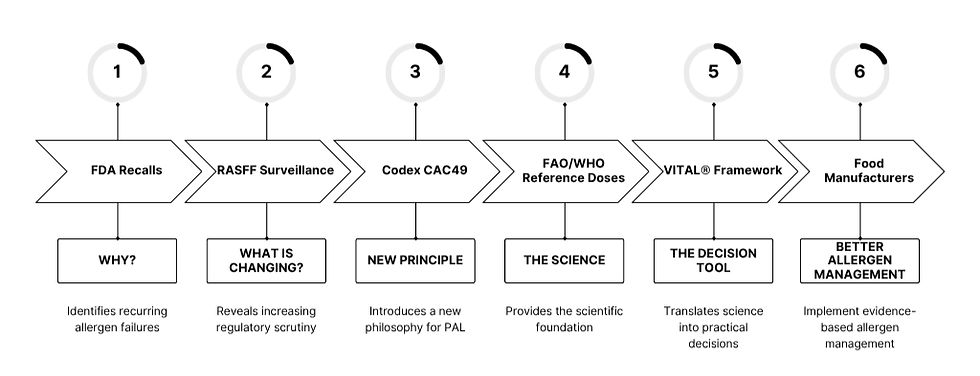
Why Incremental Improvements Are No Longer Enough
Viewed independently, the FDA and RASFF datasets each tell an important story. Viewed together, they reveal a consistent direction of travel for global allergen management.
One system demonstrates that undeclared allergens remain among the most persistent causes of food recalls. The other demonstrates that regulators are steadily strengthening surveillance, improving traceability, and paying increasing attention to labelling accuracy.
Neither dataset, however, explains how manufacturers should make better allergen labelling decisions.
They identify the problem. They reveal growing regulatory pressure. But they do not provide the framework needed to move from precaution based largely on possibility to decisions grounded in structured evidence.
That missing piece would arrive not through another recall database or another surveillance report, but through an international effort to rethink the very purpose of precautionary allergen labelling.
The first internationally harmonised response came through the Codex Alimentarius Commission, which introduced a new global direction for allergen risk management — one that would fundamentally change not only when precautionary allergen labelling should be used, but why.
The Turning Point: When "May Contain" Stopped Being Enough
The World Didn't Need More Allergen Labels. It Needed Better Decisions.
For years, precautionary allergen labelling statements seemed like the safest option. If there was even the slightest possibility that traces of an allergen could find their way into a product, many manufacturers took the conservative path. A simple "May contain…" statement appeared to solve the problem. It warned consumers, reduced perceived liability, and allowed products manufactured on shared equipment to reach the market without making difficult judgements about the actual level of risk.
Over time, however, something unexpected happened. The warning that was intended to help consumers began to lose its meaning. Supermarket shelves filled with products carrying precautionary statements. Chocolate bars, biscuits, breakfast cereals, spice blends, confectionery, snacks, and countless other foods displayed remarkably similar warnings despite being manufactured under vastly different conditions. One product might carry a genuine residual risk after extensive risk assessment, while another displayed exactly the same statement simply because it had become standard company practice.
From a manufacturer's perspective, this approach appeared practical. From a consumer's perspective, it created uncertainty. And from a regulator's perspective, it raised a far more fundamental question.
"If precautionary statements are applied inconsistently and without a common scientific basis, how can consumers distinguish between products that genuinely present a meaningful residual risk and those carrying warnings purely as a precaution?"
That question became the catalyst for one of the most significant developments in modern allergen management.
A System That Protected Manufacturers Better Than Consumers
The findings from the previous chapters already pointed towards a disconnect. The FDA analysis demonstrated that undeclared allergens continue to drive hundreds of recalls despite existing allergen declaration requirements. The RASFF analysis showed that regulators are strengthening surveillance, traceability, and scrutiny of labelling across international supply chains. Together, these findings suggested that simply adding more warnings was not preventing allergen incidents.
The inconsistency becomes more apparent when the evolution of precautionary allergen labelling is examined more closely. For many years, precautionary allergen labelling evolved without a globally harmonised framework. Different countries, different retailers, and often different manufacturers made their own decisions about when precautionary statements should be applied. The result was an increasingly inconsistent landscape where identical products could carry different warnings depending on who manufactured them or where they were sold.
This inconsistency produced consequences that extended well beyond regulatory compliance. Many manufacturers adopted precautionary statements as a default legal safeguard rather than the outcome of a structured assessment. Consumers living with food allergies were then faced with an impossible decision. Either they eliminated a growing number of products from their diet, often unnecessarily, or they began ignoring precautionary statements altogether because they appeared on so many foods.
Neither outcome improved consumer protection. In fact, excessive precautionary labelling risked achieving the opposite of its intended purpose by reducing confidence in the warnings themselves.
For the food industry, this represented an uncomfortable truth. A precautionary statement is only valuable if consumers believe it reflects a genuine and meaningful assessment of risk.
July 2026: A Landmark Decision on Precautionary Allergen Labelling (PAL)
On 6 July 2026, the 49th Session of the Codex Alimentarius Commission (CAC49) adopted new Guidelines on the Use of Precautionary Allergen Labelling (PAL) as part of the General Standard for the Labelling of Pre-packaged Foods (CXS 1-1985).
The adoption of these guidelines has been widely recognised as one of the most significant international developments in allergen management in recent years. If we describe this as another update to food labelling guidance, that would completely miss its significance.
Codex did not simply revise the wording around precautionary allergen labelling. It challenged the philosophy that had guided precautionary statements for decades.
The question was no longer:
"Could cross-contact occur?"
Instead, manufacturers would increasingly be expected to ask:
"After implementing appropriate allergen controls, does the remaining unintended allergen presence present sufficient risk to justify a precautionary statement?"
That single change transforms precautionary allergen labelling from a cautious assumption into a documented risk-management decision.
From Possibility to Probability
The shift can be illustrated through a simple comparison of the two approaches. For many years, allergen management often followed a hazard-based approach.
Traditional Thinking
Cross-contact possible?

↓

Yes

↓

Apply "May Contain"
The logic was understandable. If cross-contact could not be ruled out completely, applying a precautionary statement appeared to be the safest option.
But this approach had one important weakness. It treated every possibility as though it represented the same level of risk. A hypothetical trace amount carried exactly the same warning as a situation where meaningful unintended allergen presence was far more likely.
The new Codex philosophy introduces an entirely different sequence.
Modern Risk-Based Thinking
Hazard identified

↓

Apply allergen management controls

↓

Assess unintended allergen presence

↓

Conduct risk assessment

↓

Compare against action level

↓

Determine whether PAL is justified
This is much more than a different flowchart. It represents a different way of thinking about allergen management itself.
The objective is no longer to ask whether cross-contact is theoretically possible. The objective is to understand whether, after all reasonable controls have been applied, the remaining unintended allergen exposure represents a scientifically meaningful risk.
PAL Moves to the End of the Process
Perhaps the most important message emerging from the Codex guidance is that precautionary allergen labelling is no longer viewed as an early control measure. It becomes the last one.
According to the Codex Alimentarius Commission's guidance, precautionary allergen labelling should only be considered after manufacturers have implemented appropriate allergen management measures and completed a documented assessment demonstrating that the estimated unintended allergen presence exceeds the relevant action level.
This changes the role of the precautionary statement completely. Instead of compensating for uncertainty, it now follows documented efforts to reduce uncertainty. The sequence becomes clear:
Supplier allergen information
Ingredient control
Production segregation
Scheduling to minimise cross-contact
Cleaning validation
Verification activities*
Risk assessment
*Verification activities may include analytical methods such as ELISA or qPCR where appropriate. However, testing supports allergen management decisions — it does not replace them.
Related Reads:
Only after these controls have been applied should a manufacturer decide whether precautionary allergen labelling remains necessary. This is a subtle change in wording, but a profound change in responsibility.
The label is no longer expected to compensate for weaknesses elsewhere in the food safety system. It becomes evidence that the system has already done everything reasonably possible.
Table 5. How the Philosophy of Precautionary Allergen Labelling Has Changed
Traditional Approach | Emerging Codex Approach |
Focus on the possibility of cross-contact | Focus on the level of residual risk after controls |
Precautionary statement often applied early | Precautionary statement considered only after documented risk assessment |
Decisions frequently based on qualitative judgement | Decisions increasingly supported by documented evidence |
PAL often used as a precautionary safeguard | PAL becomes the final outcome of allergen management |
A Higher Standard of Evidence
This evolution inevitably changes what regulators, certification bodies, customers, and auditors are likely to expect from manufacturers.
Historically, the question might have been:
"Do you have allergen controls?"
Increasingly, it is becoming:
"How did you decide that this product does—or does not—require a precautionary statement?"
Answering that question requires evidence.
Manufacturers are increasingly expected to support these decisions with documentation such as:
Supplier allergen information
Production scheduling records
Cleaning validation
Environmental or product testing where appropriate
Exposure assessment
Documented allergen risk assessments
Justification for the presence—or absence—of precautionary allergen labelling.
Notice that the emphasis is not on collecting more paperwork. It is on demonstrating that labelling decisions can be explained logically, consistently, and scientifically. That distinction will become increasingly important for export-oriented manufacturers operating across multiple regulatory environments.
The Missing Piece Still Remained
By this stage, the global direction had become much clearer. The FDA data established that undeclared allergens continue to drive recalls. RASFF demonstrated that regulators are strengthening surveillance and paying increasing attention to labelling accuracy. Codex introduced a new philosophy in which precautionary allergen labelling should be the outcome of structured risk assessment rather than default precaution.
Yet one practical question remained unanswered.
"How should manufacturers actually determine whether the remaining unintended allergen exposure is significant enough to justify a precautionary statement?"
Saying that decisions should be "science-based" is one thing. Applying that principle consistently across thousands of products, serving sizes, manufacturing processes, and allergens is another.
Codex deliberately established the direction.
The defensible framework that makes this possible comes from the FAO/WHO Expert Consultation on Food Allergens, which introduced the concepts of Reference Doses and Action Levels — the tools that transform risk-based allergen management from a philosophy into a practical decision-making framework.
The Science Behind Better Decisions
From "Can It Happen?" to "Will It Harm?"
By the time the Codex Alimentarius Commission adopted its new guidance in 2026, one thing had become obvious. The food industry could no longer rely on intuition alone to make precautionary allergen labelling decisions.
Saying that a precautionary statement should be "science-based" sounds sensible, but it immediately raises another question:
"What exactly does "science-based" mean?"
"If two manufacturers produce similar products using comparable ingredients, should they always arrive at the same labelling decision?"
"If one factory detects minute traces of an allergen while another detects none, should their labels necessarily be different?"
"More fundamentally, should every detectable trace automatically result in a precautionary statement?"
These were not theoretical questions. They represented the practical challenge regulators had been struggling to solve for years.
The Codex guidance established what should happen. The scientific methodology explaining how to make those decisions came from the joint work of the Food and Agriculture Organization (FAO) and the World Health Organization (WHO). Their work transformed precautionary allergen labelling from a largely qualitative judgement into a structured, evidence-based risk assessment.
The Biggest Misunderstanding About Allergens
For many years, allergen management revolved around a single assumption:
"If any allergen is present, the product should carry a precautionary statement."
It sounds logical.
Unfortunately, it is not how modern risk assessment works. The FAO/WHO expert consultations did not begin because food allergies were suddenly becoming more common. They began because different countries, companies and retailers were making completely different decisions about the same level of unintended allergen presence. There was no harmonised scientific basis for deciding when precautionary allergen labelling was genuinely warranted.
The experts reframed the problem. Instead of asking:
"Could cross-contact occur?"
They asked:
"If cross-contact occurs, how much allergenic protein might actually be present, and is that amount likely to cause harm?"
That shift may appear subtle, but it fundamentally changes how allergen risks are evaluated.
Reference Doses: A Health-Based Starting Point
At the heart of the FAO/WHO framework lies the concept of a Reference Dose (RfD). A Reference Dose represents the amount of allergenic protein from a particular food that can be consumed on a single eating occasion with no appreciable health risk for the vast majority of allergic individuals. Importantly, it is derived from clinical oral food challenge data rather than analytical laboratory capability.
That distinction deserves emphasis because it is frequently misunderstood. A Reference Dose is not:
a legal limit,
a manufacturing specification,
a laboratory detection limit,
or an "allergen-free" threshold.
Instead, it is a health-based value developed from extensive clinical evidence collected from allergic individuals. In other words, Reference Doses are derived from clinical evidence rather than analytical capability.
Why "Zero" Is Not the Objective
Perhaps the most uncomfortable message for the food industry is also the most realistic.
Modern food manufacturing cannot always eliminate every microscopic trace of an allergen. Shared production equipment, agricultural commingling, transportation systems, ingredient sourcing, and increasingly complex supply chains all create opportunities for unintended allergen presence. Completely eliminating every possibility is often technically impossible.
The objective, therefore, is not absolute absence. It is reducing unintended allergen exposure to a level that presents no appreciable health risk for the overwhelming majority of allergic consumers.
This represents an important shift in allergen management. For decades, allergen management largely pursued hazard elimination. Modern allergen management focuses on risk reduction supported by evidence.
From Clinical Science to Factory Decisions
A Reference Dose alone cannot tell a manufacturer whether a precautionary statement is required.
Consumers do not eat "milligrams of allergenic protein." They eat portions of food. This is where Action Levels become essential.
An Action Level converts a health-based Reference Dose into a practical manufacturing decision by considering how much of the food is likely to be consumed in one eating occasion. Two products may therefore have different acceptable allergen concentrations simply because their serving sizes differ. A spice blend consumed in two grams and a ready meal consumed in 250 grams cannot be evaluated using the same concentration threshold.
This provides the missing bridge between clinical science and food manufacturing. Instead of relying on assumptions, manufacturers can begin asking:
"Given the likely serving size of this product and the estimated unintended allergen presence, does the residual risk justify precautionary allergen labelling?"
That is a fundamentally different conversation from simply asking whether cross-contact is possible.
Science Alone Doesn't Make Decisions
Reference Doses and Action Levels are powerful tools, but they are not intended to replace food safety systems. In practice, manufacturers seeking to justify the absence of precautionary allergen labelling increasingly rely on documented evidence including supplier declarations, process flow analysis, cross-contact assessment, cleaning validation, analytical testing where appropriate, and structured risk assessment before comparing outcomes against relevant Action Levels.
Notice how the decision-making pathway has changed.
Evidence → Risk Assessment → Labelling
rather than
Possibility → "May Contain."
The science is now in place. The remaining challenge is implementing it consistently on the factory floor.
That is precisely the role played by one of the food industry's most influential allergen risk assessment frameworks.
What This Means for Manufacturers Reference Doses and Action Levels do not replace allergen management controls. They provide a structured framework for evaluating the residual risk that remains after those controls have been implemented. For manufacturers, this means that precautionary allergen labelling should become the outcome of documented decision-making rather than the starting point. |
From Science to the Factory Floor
How Leading Manufacturers Turn Evidence into Decisions
Having a scientific framework is one thing. Using it consistently across hundreds of products, multiple manufacturing lines, changing suppliers, and thousands of production batches is another. This is where many discussions on allergen management become disconnected from reality.
Food manufacturers do not operate in laboratories. They operate in factories where ingredients change, production schedules evolve, equipment is shared, recipes are reformulated, and customer expectations continue to grow.
The challenge has never been understanding allergen science. The challenge has been translating that science into repeatable manufacturing decisions.
VITAL®: Making Risk Assessment Practical
To address that challenge, the Australian food industry developed the Voluntary Incidental Trace Allergen Labelling (VITAL®) programme through the Allergen Bureau.
Today, the Allergen Bureau's VITAL® Programme is recognised as one of the world's most influential allergen risk assessment frameworks and formed part of the evidence-based foundation considered during FAO/WHO discussions on Reference Doses.
VITAL does not begin with laboratory testing. It begins with understanding the manufacturing process. Its logic is remarkably straightforward:
Identify where cross-contact may occur.
Estimate unintended allergen presence.
Consider the expected serving size.
Compare the estimated exposure with the relevant Action Level.
Decide whether precautionary allergen labelling is scientifically justified.
Perhaps the most important lesson is what VITAL does not do. It does not replace Good Manufacturing Practices. Supplier control, segregation, cleaning validation, production scheduling, and verification remain the foundation. Risk assessment becomes meaningful only after these controls are functioning effectively. Read our Step-by-Step Guide to In-House Food Testing Lab Setup in a Manufacturing Industry for understanding how a well-designed laboratory can help in implementation of effective controls.
Why Testing Alone Cannot Solve the Problem
One misconception continues to appear across the industry. A laboratory result showing "no detectable allergen" is often interpreted as proof that precautionary labelling is unnecessary.
Current international guidance consistently recognises analytical testing as one component of allergen management rather than the sole basis for labelling decisions. Sampling limitations, matrix effects, measurement uncertainty and process variability mean laboratory results are most valuable when used to verify assumptions rather than replace documented risk assessment. Choosing between molecular and protein-based methods depends on the specific verification objective rather than the testing technology itself. For a detailed comparison, see our guides on Allergen Testing in the Food Industry: ELISA vs PCR and Other Methods.
This explains why leading manufacturers rarely describe their allergen strategy in terms of laboratory capability alone. Their strength lies in robust systems.
What Leading Manufacturers Actually Implement
A review of publicly available allergen management information from major global food manufacturers reveals an interesting pattern. Few emphasise that they "use VITAL." Instead, they describe comprehensive allergen management programmes built around supplier approval, allergen mapping, production scheduling, dedicated equipment where feasible, validated cleaning, label verification, and documented risk assessment. These are precisely the operational controls assumed by the VITAL framework.
In other words, the world's leading manufacturers are not relying on a calculator. They are relying on disciplined food safety systems. Building those systems begins with strong allergen management fundamentals, including supplier control, segregation, cleaning validation, staff training, and verification activities. Readers looking for a broader introduction to these principles can explore our guide: Navigating Allergen Management in the Food Industry: Its Critical Importance and Testing Essentials.
What This Means for Manufacturers VITAL is not an allergen management system. It is a decision-support framework used within an effective allergen management system. Manufacturers that focus only on the calculation without strengthening supplier management, segregation, cleaning validation, production planning and verification are unlikely to achieve the intended benefits of evidence-based precautionary allergen labelling. |
Are Existing Food Safety Standards Ready?
For organisations already certified to food safety standards like FSSC 22000 or BRCGS, this transition should not be viewed as building a new management system.
Most of the required foundations already exist. FSSC 22000 incorporates prerequisite programmes covering allergen management, prevention of cross-contamination, cleaning, supplier management, verification and continual improvement. What changes under the emerging global direction is not the existence of these controls but the quality of evidence supporting allergen labelling decisions. Auditors may increasingly ask not only whether allergen controls exist, but how the absence or presence of precautionary allergen labelling has been justified.
Similarly, BRCGS has long treated allergen management as an integrated system involving supplier assurance, segregation, production planning, cleaning validation, label verification, change management, and staff training. The direction established by Codex aligns closely with this systems-based approach.
The message is reassuring. For many manufacturers, this is an evolution rather than a reinvention. For complete guidance read our article on How to Build Export-Ready Food Safety Systems That Win International Buyers.
What About India?
The Indian regulatory landscape presents a unique situation. Current FSSAI regulations require mandatory declaration of specified allergens where applicable but do not currently provide an evidence-based framework for precautionary allergen labelling equivalent to the Codex guidance or the Allergen Bureau's VITAL® Programme.
However, that should not be interpreted as a reason to wait. History shows that international customer expectations often evolve before national regulations. Food safety culture, food fraud, and food defence followed exactly this pattern. Export-oriented manufacturers adopted these practices years before they became widespread regulatory expectations. Refer our article on Foreign Buyer Audit Checklist for Food Manufacturers in India for detailed understanding.
The same trajectory appears increasingly likely for evidence-based allergen management.
Indian manufacturers supplying spices, bakery products, nutraceuticals, dairy ingredients, confectionery and ready-to-eat foods may find that international customers begin requesting documented allergen risk assessments, cleaning validation, supplier controls, and justification for precautionary statements long before domestic regulations require them.
A Practical Readiness Checklist
As the industry moves toward evidence-based precautionary allergen labelling, manufacturers should begin asking a different set of questions:
Key Question | Why It Matters |
Do we know every allergen entering our facility? | Effective control begins with complete visibility. |
Have we mapped every realistic cross-contact point? | Hidden transfer routes often create the greatest risk. |
Are supplier allergen declarations routinely reviewed? | Raw material changes can alter risk profiles overnight. |
Is production scheduling designed to minimise cross-contact? | Prevention remains more effective than corrective action. |
Have cleaning procedures been validated rather than assumed? | Validation provides objective evidence of control effectiveness. |
Can every precautionary statement be scientifically justified? | Future expectations are increasingly focused on documented evidence. |
These questions are not merely preparation for future regulations. They represent good manufacturing practice today.
Conclusion: The Future Has Already Started
The story of precautionary allergen labelling is no longer simply about words printed on a package. It is the story of an industry moving from possibility to probability, from assumption to evidence, and from precaution alone to demonstrable risk management.
Analysis of official U.S. FDA recall data demonstrated why change was needed. The European Commission's RASFF reports showed that regulatory scrutiny is becoming increasingly preventive. The Codex Alimentarius Commission established the international direction, the FAO/WHO Expert Consultation provided the scientific foundation, and the Allergen Bureau's VITAL® Programme translated that science into a practical decision-making framework.
FSSC 22000 and BRCGS already provide much of the operational framework needed to support this evolution, while export-focused manufacturers — including those in India —are likely to encounter these expectations through customers and certification schemes before they appear in national legislation.
The future of allergen management will not be measured by how often a product carries a precautionary statement. It will be measured by whether every such statement — or the decision not to use one — is supported by robust process controls, documented evidence, and scientifically defensible risk assessment.
Manufacturers that begin strengthening these capabilities today will be better positioned not only for future regulatory developments, but also for evolving customer expectations, certification audits, and increasingly complex global supply chains. In doing so, they will build more resilient food safety systems, strengthen consumer confidence, and improve long-term access to international markets.
What This Means for Manufacturers The future of precautionary allergen labelling is unlikely to be defined by new warning statements. It will be defined by better decisions. Manufacturers that invest in robust allergen management systems, documented risk assessments, validated controls, and evidence-based decision-making will be best positioned to meet evolving regulatory expectations while maintaining consumer trust. |
Frequently Asked Questions (FAQs)
1. What is Precautionary Allergen Labelling (PAL)?
Precautionary Allergen Labelling (PAL) refers to voluntary statements such as "May Contain", "May Contain Traces of", or "Produced in a Facility That Also Processes..." used to communicate the potential presence of unintended allergens resulting from cross-contact during manufacturing. Unlike mandatory allergen declarations, PAL is intended to warn consumers about residual allergen risks that cannot be completely eliminated despite appropriate control measures. International guidance is increasingly moving towards using PAL only when supported by documented, evidence-based risk assessment.
2. When should a "May Contain" statement be used?
Current international guidance indicates that a precautionary allergen statement should not be used as a default precaution. It should only be considered after appropriate allergen management controls have been implemented and a documented risk assessment concludes that a meaningful residual risk of unintended allergen presence remains. In other words, PAL should be the outcome of a structured decision-making process—not a substitute for effective allergen management.
3. What is the difference between mandatory allergen declaration and Precautionary Allergen Labelling?
Mandatory allergen declarations identify allergens that are intentionally added as ingredients to a food product and are required by food regulations. Precautionary Allergen Labelling, on the other hand, addresses the possibility of unintended allergen presence due to cross-contact during manufacturing, storage, or transportation. While mandatory declarations are regulatory requirements, PAL is generally voluntary and increasingly expected to be supported by scientific risk assessment rather than applied routinely.
4. Why is the traditional "May Contain" approach changing?
Analysis of official U.S. FDA recall data and findings from the European Commission's Rapid Alert System for Food and Feed (RASFF) suggest that allergen-related incidents continue despite widespread use of precautionary statements. At the same time, international guidance has recognised that inconsistent use of PAL can reduce consumer confidence and make it difficult for allergic individuals to distinguish between products with genuine residual risk and those carrying precautionary statements as a general precaution. This has driven the transition towards evidence-based allergen risk assessment.
5. What are Reference Doses and Action Levels?
Reference Doses are health-based values developed from clinical oral food challenge data that represent an amount of allergenic protein expected to pose no appreciable health risk for the vast majority of allergic individuals. Action Levels convert those Reference Doses into practical manufacturing thresholds by considering the expected serving size of a food product. Together, they provide a structured framework for evaluating whether precautionary allergen labelling is scientifically justified.
6. What is the VITAL® Programme?
The Voluntary Incidental Trace Allergen Labelling (VITAL®) Programme, developed by the Allergen Bureau, is a structured allergen risk assessment framework. Rather than relying solely on laboratory testing, VITAL considers factors such as cross-contact potential, estimated unintended allergen presence, serving size, and Action Levels to help manufacturers determine whether precautionary allergen labelling is warranted. It is intended to support—not replace—effective allergen management systems.
7. Is laboratory testing alone sufficient to justify allergen labelling decisions?
No. Laboratory testing is an important verification tool, but international guidance recognises that it should not be the sole basis for precautionary allergen labelling decisions. Sampling limitations, food matrix effects, measurement uncertainty, and process variability mean that analytical results should be interpreted alongside supplier information, process controls, cleaning validation, cross-contact assessments, and documented risk assessment.
8. How do FSSC 22000 and BRCGS support allergen management?
Both FSSC 22000 and BRCGS require organisations to implement comprehensive allergen management programmes covering supplier assurance, segregation, cleaning validation, production planning, labelling verification, staff training, and continual improvement. While these standards already provide many of the operational controls needed for effective allergen management, manufacturers are increasingly expected to demonstrate how decisions regarding precautionary allergen labelling are supported by documented evidence and structured risk assessment.
9. Does India currently have a science-based framework for Precautionary Allergen Labelling?
Current FSSAI regulations require mandatory declaration of specified allergens where applicable but do not presently provide a science-based framework for precautionary allergen labelling equivalent to the Codex guidance or the Allergen Bureau's VITAL® Programme. However, export-oriented manufacturers may increasingly encounter customer and certification requirements aligned with international best practices before similar expectations are formally incorporated into national regulations.
10. How can food manufacturers prepare for the future of evidence-based allergen labelling?
Manufacturers should focus on strengthening their allergen management systems rather than relying on precautionary statements alone. This includes maintaining accurate supplier allergen information, identifying potential cross-contact points, validating cleaning procedures, reviewing production scheduling, documenting allergen risk assessments, and ensuring that every precautionary statement—or decision not to use one—is supported by objective evidence. Organisations that build these capabilities today will be better positioned for evolving regulatory expectations, certification audits, and international market requirements.
References
The following primary sources and internationally recognised guidance documents informed the preparation of this article.
U.S. Food and Drug Administration (FDA). Food Recall XML Datasets (2020–July 2026). Analysis of official FDA recall records conducted for this article.
European Commission. Rapid Alert System for Food and Feed (RASFF) Annual Reports (2021–2025).
Codex Alimentarius Commission (CAC49). Guidelines on the Use of Precautionary Allergen Labelling (PAL), adopted as part of the General Standard for the Labelling of Pre-packaged Foods (CXS 1-1985), July 2026.
Food and Agriculture Organization (FAO) & World Health Organization (WHO). Expert Consultation on Food Allergens – Risk Assessment, Reference Doses and Action Levels.
Allergen Bureau. VITAL® (Voluntary Incidental Trace Allergen Labelling) Programme – Framework and Implementation Guidance.
FSSC 22000 Foundation. FSSC 22000 Scheme Requirements, Version 6.
BRCGS. Global Standard Food Safety and published guidance on allergen management.
Food Safety and Standards Authority of India (FSSAI). Food Safety and Standards (Labelling and Display) Regulations and related allergen declaration requirements.
Continue Exploring Food Safety Resources
Building an evidence-based allergen management programme is only one part of developing a robust food safety system. Depending on your organisation's needs, you may also find these resources helpful:
FSSC 22000 Implementation & Consulting – Learn how a structured food safety management system supports allergen management, risk assessment, and continual improvement.
Food Testing Laboratory Setup – Planning an in-house laboratory? Explore our approach to laboratory design, equipment selection, and quality systems.
Food Safety Consulting Services – Discover how we support food manufacturers with HACCP, FSSC 22000, allergen management, supplier approval, and export compliance.
Food Safety Training Programmes – Build internal capability through practical training for QA, QC, Production, and Technical teams.
Food Safety Resources & Technical Articles – Explore our growing library of practical guides on food safety, laboratory testing, quality systems, and regulatory compliance.
About the Author
Dr. Raina Jain is the Founder of 2F Quality Solutions and a food safety consultant with over 15 years of experience across food manufacturing units, food testing laboratories, and and international food safety standards. She has supported food manufacturers with laboratory setup, FSSC 22000 implementation, allergen management, export readiness, and technical training across multiple sectors. Her work focuses on helping manufacturers build practical, science-based food safety systems that strengthen compliance and consumer confidence.
Need Support with Allergen Management?
Whether you're reviewing precautionary allergen labelling decisions, implementing FSSC 22000, strengthening your allergen management programme, preparing for export markets, or establishing an evidence-based risk assessment process, 2F Quality Solutions provides practical technical support tailored to food manufacturers.
Our services include:
Allergen risk assessment and management
FSSC 22000, HACCP and food safety system implementation
Supplier approval and allergen control programmes
Cleaning validation and cross-contact risk assessment
In-house food testing laboratory setup
Food testing strategy and laboratory coordination
Export readiness and international compliance support
Technical training for QA, QC and production teams
Get in touch with our technical team at info@2fquality.com to discuss your food safety and allergen management requirements.


Comments